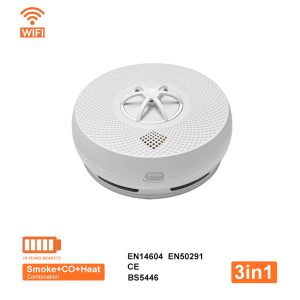
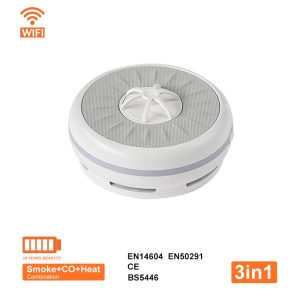
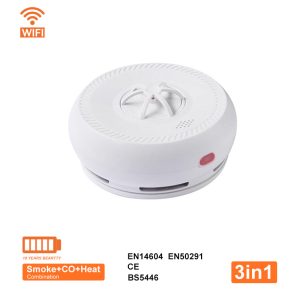
Hardwired smoke alarms with a battery backup are a reliable fire safety option that connects to your home’s main electrical system and uses a backup battery to ensure continuous operation during a power outage. They are a common and often legally required choice in many new or renovated homes.

Technical Advantages: Multiple Protection Mechanisms
Dual Power Supply System
Hardwired smoke alarms are powered by the household circuit (usually 120V or 240V) and have a built-in backup battery (such as a 9V replaceable battery or a 10-year replacement-free lithium-ion battery). This design solves the problem of traditional battery-operated alarms failing due to depletion of power, allowing them to continue operating even during power outages. For example, First Alert’s SMI105-AC model uses a 10-year lithium-ion battery, eliminating the need for frequent replacements and significantly reducing maintenance costs.
Smart Interconnected System
Multiple alarms can synchronize alarms through the “Interconnectivity” function. When smoke is detected in a certain area, all connected alarms will trigger simultaneously, buying family members time to escape. Some high-end models support integration with smart home systems, sending alarm information to mobile phones.
Precise Sensing Technology
Mainstream products use photoelectric sensors or ionization sensors. The former is more sensitive to smoldering fires (such as mattresses or curtains on fire), while the latter excels at detecting rapidly burning open flames. Some high-end models (such as Dual-Sensors) combine both technologies to achieve comprehensive coverage.
Legal Requirements and Installation Standards
Mandatory Installation Scenarios
Many regulations require newly built or renovated residences to install hardwired alarms. For example, Queensland, Australia, mandates that all residences be equipped with standard interconnected photoelectric alarms by 2027. The US NFPA (National Fire Protection Association) also recommends installing alarms on each floor, in bedrooms, and in hallways, with protection via AFCI (Arc Fault Circuit Interrupter) circuitry.
Professional Installation Requirements
Hardwired alarms must be installed by a certified electrician to ensure that the circuit connections meet safety standards. Self-installation may result in false alarms, missed alarms, circuit malfunctions, or even violations of building codes. For example, the Brisbane Fire Service emphasizes that any retrofitting project must pass a safety inspection, or may face fines.
Maintenance and Lifespan Management
Daily Maintenance Guidelines
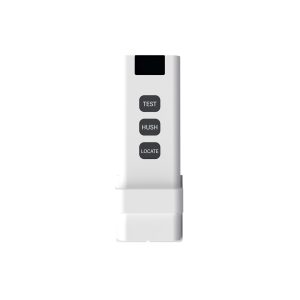
- Monthly Test: Press the test button to confirm alarm response and check if the interconnected system is functioning correctly.
- Annual Battery Replacement: Even if the spare battery is not depleted, it is recommended to replace it annually to maintain performance (e.g., the 10-year battery for the First Alert SMI105-AC).
- Sensor Cleaning: Clean the vents with a soft brush every six months to prevent false alarms.
Equipment Replacement Cycle
Hardwired alarms typically have a lifespan of 10 years. After this period, sensor sensitivity decreases, requiring complete replacement. Some models (such as the Kidde AC Hardwired) offer an “end-of-life” warning function, alerting the user with a flashing indicator light.
Purchase and Upgrade Recommendations
Core Parameter Selection
- Alarm Type: Prioritize photoelectric sensors, especially suitable for areas like kitchens and bedrooms.
- Battery Type: 10-year lithium-ion batteries offer peace of mind and avoid frequent replacements.
- Additional Functions: Voice prompts, LED status lights, and tamper-proof design enhance usability.
Existing System Upgrade Plan
If your existing alarm is battery-powered or non-interconnected, you can gradually replace it with a wired model, allowing for seamless integration into the existing circuitry without rewiring.