

Over the past few decades, the widespread use of smoke detectors has significantly reduced fire-related deaths and injuries. These small devices have become the unsung heroes of home safety. However, a disturbing reality remains: thousands of people still die or suffer life-altering injuries in home fires every year.

The Harsh Reality: While smoke detectors are estimated to reduce the risk of dying in a house fire by at least 50%, this protection only exists if the device is actually functioning. Statistics show that smoke alarms are installed in about 96% of US homes, yet approximately 20% of them are non-operational.
The Problem: Why Do Detectors Fail?
Research from the National Institute of Standards and Technology (NIST) reveals a troubling breakdown of fire deaths:
- 34% of civilian deaths occurred in homes with operating smoke alarms.
- 22% occurred in homes where alarms were present but failed to operate.
- 43% occurred in homes with no smoke alarms at all.
It is estimated that if every home had working smoke alarms, U.S. residential fire deaths could drop by an additional 36%, saving approximately 1,100 lives annually. So, why are so many detectors defective?
The “Test Button” Myth and Accessibility Issues
The standard advice is to “press the test button” weekly or monthly. But let’s examine the practical challenges of this recommendation:
- The Reach Problem: Smoke detectors are typically installed on ceilings, 8 feet or higher above the floor. Reaching them requires a chair, stepladder, or stool. How many homeowners will realistically do this every week?
- Mobility Issues: What about the elderly, the infirm, or those who are wheelchair-bound? For them, testing a ceiling-mounted detector is a significant physical challenge.
- Older Models: Millions of older smoke detectors lack test buttons entirely, leaving homeowners with no easy way to verify functionality.

Common Causes of Detector Failure
Beyond just “dead batteries,” several factors can render a smoke detector useless:
- Power Issues: Weak, dead, or missing batteries, or intentional disconnection to stop nuisance alarms.
- Environmental Obstruction: Vents clogged with dust, grease, or even insect infestations.
- Age: Detectors past their life expectancy (typically 8-10 years) suffer from corroded contacts and faulty electronics.
- Damage: Painting over a detector can block the vents, preventing smoke from entering the sensing chamber.
Ionization vs. Photoelectric: Which is Better?
Understanding the type of detector in your home is crucial. There are two main technologies:
| Feature | Ionization Detectors | Photoelectric Detectors |
|---|---|---|
| Technology | Uses radioactive material to create an electric charge; smoke disrupts the charge. | Uses a beam of light; smoke breaks or deflects the beam. |
| Prevalence | ~75% of US homes (due to lower cost) | Less common, but gaining traction |
| Sensitivity | Highly sensitive to microscopic particles; prone to nuisance alarms from cooking, showering, or cleaning sprays. | More stable; less likely to trigger false alarms from everyday activities. |
| The “Battery Removal” Issue | High – homeowners often remove batteries to stop false alarms. | Low – fewer false alarms mean batteries stay in place. |
The super-sensitivity of ionization detectors is a double-edged sword. While designed to detect minute combustion particles, they often react to normal kitchen activities or steam from bathrooms. This leads to the most dangerous outcome: homeowners simply removing the batteries to stop the noise, leaving the home unprotected.

The Solution: A Modern Approach to Safety
What Homeowners Should Do:
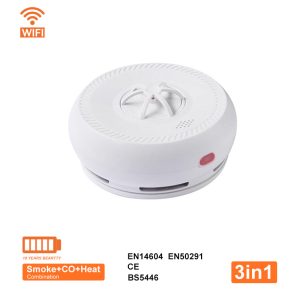
- Upgrade to 10-Year Sealed Battery Units: These detectors come with a non-removable, sealed lithium battery that lasts a decade. No more battery replacements, no more “chirping” at 3 AM, and no temptation to remove batteries.
- Choose Photoelectric Technology: Especially in kitchens and living areas, photoelectric detectors provide reliable protection without the nuisance of constant false alarms.
- Hardwire with Battery Backup: For maximum reliability, install detectors powered by household current with a battery backup for power outages.
- Replace Every 10 Years: A smoke detector that has been in operation for 10 years has gone through more than 3.5 million monitoring cycles. If in doubt, replace it.
- Proper Placement: Install detectors on every level of your home, especially near sleeping areas and in the kitchen (preferably with photoelectric technology).

A Call to Action for Manufacturers
To truly address this public safety crisis, manufacturers must also step up:
- Educate the Public: Launch campaigns to raise awareness that smoke detectors wear out and need replacement every decade.
- Offer Trade-In Incentives: Encourage homeowners to swap out old units for modern, reliable alternatives.
- Phase Out Ionization for Residential Use: Focus production on photoelectric models or sealed 10-year battery units to eliminate the nuisance alarm problem.
- Simplify User Manuals: Rewrite instructions with clear graphics and plain language so every homeowner can understand how to maintain their devices.







Leave A Comment