

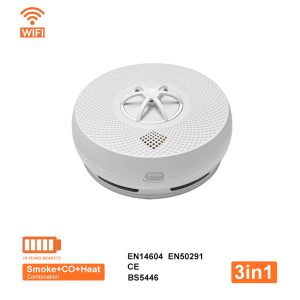
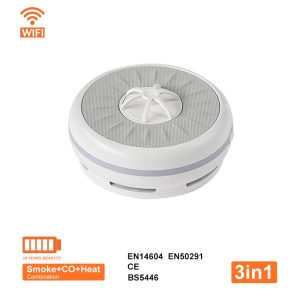
Yes, this statement is completely correct. The combined carbon monoxide and smoke detector is indeed superior to a single smoke detector, with its core advantages being earlier warning, lower false alarm rate, and multifunctional integration.
Core advantages of composite carbon monoxide and smoke detectors
Extremely early fire warning capability
The smoldering stage of a fire (before producing open flames or thick smoke) will release a large amount of carbon monoxide (CO), and the composite detector can trigger an alarm several minutes to tens of minutes in advance through the CO sensor.
Data comparison: The Anka three composite detector (smoke+temperature+CO) responds more than 60 seconds faster to the standard test fire TF7 than a single smoke detector (CO alarm in 530 seconds, smoke alarm in 760 seconds).
Significantly reduce false alarm rate
Through multi-sensor collaborative algorithms (such as Hanwei’s “Black and White Smoke Recognition Algorithm”), real fires can be distinguished from interference sources such as cooking steam and dust.
A single smoke detector is prone to false alarms due to the influence of water vapor and dust, while a composite detector combined with CO concentration data (non fire vapor does not produce CO) reduces the false alarm rate by 30% -50%.
Multi functional integration and cost optimization
Single device achieves dual protection, saving installation space and wiring costs, especially suitable for scenarios such as homes and small shops.
Low power design (such as 15 μA standby current) extends battery life to several years and reduces maintenance frequency.










Leave A Comment